
Electricity Forum Electricity Today Magazine Arc Flash Training

Testing & Maintenance


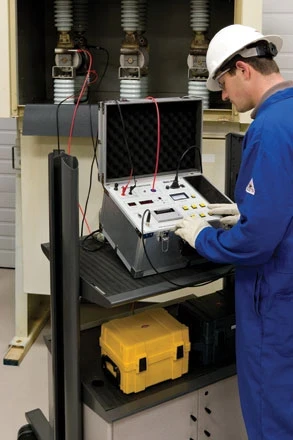
Understanding the DC Overpotential Test

The 411 on DC testing of low-voltage circuit breakers BY JIM WHITE, Shermco Industries, Inc. The direct current (DC) overpotential test is one of the basic tests conducted to ensure an insulation system has adequate insulation life to make it to the next scheduled maintenance interval. While not...
Transformer Testing & Maintenance

Vibro-Acoustic Diagnostics for OLTCs

On-load tap changers (OLTCs) are crucial components within power transformers, enabling voltage regulation while the transformer remains energized. Maintaining the health of OLTCs is essential for ensuring grid reliability and efficient power delivery. Traditionally, diagnosing potential problems...


CSA Z462 and CSA Z463: A Powerful Combination

I recently viewed a destroyed 600-volt electrical panel board that had exploded when an operator reset an 800-ampere (A) breaker. His leather-palmed gloves had synthetic backs that ignited and seriously burned the back of his hands. His flame-resistant (FR) shirt was untucked and he was burned on...

Safe Electrical Maintenance Checklist

Reduce the risk of arc flash hazards with CSA Z462 BY ROBERT BURGESS, Lineman’s Testing Laboratories Safe electrical maintenance practices and on-going personnel training can minimize the likelihood of electrical injuries and fatalities due to electrical shock, electrocution, arc flash and arc...

Wireless Measurement Systems

Conquering challenges with wireless measurement systems BY COLIN PLASTOW, Fluke Electronics Any type of manufacturing or industrial environment presents a number of challenges when taking measurements. Whether you need to check performance over time or run spot checks, there are many situations...

Testing

Vacuum Interrupter Testing

Predicting remainder of field life finally becomes easier

BY FINLEY LEDBETTER, Group CBS

Vacuum interrupters (VIs) have widely replaced older air-magnetic and oil interrupters for circuit breakers rated at one kilovolt (kV) or higher. These devices offer up to 10 times the expected lifetime than newer SF6 (sulfur hexafluoride) gas interrupters.

Unfortunately, nothing lasts forever. Manufacturers predict that most of their interrupters have a service life of 20 years; however, users generally ignore this fact....

Testing Articles